

 English
 French
Are you still fighting low answer rates, rising compliance pressure, and unpredictable pipeline results in 2025?
Chances are, it’s not your agents or your technology. It’s the outdated lead generation beliefs that still shape how you run outbound every day.
You’re working in a calling environment that has changed faster than most strategies. Carriers filter calls more aggressively. Customers expect more transparency. Regulations impact nearly every outreach workflow you employ. But if you’re still operating on old assumptions, you’re automatically playing from behind.
75% of people won’t pick up numbers they don’t recognize. Customer issues, such as outdated processes, high call volumes, and inefficient workflows, can reduce system efficiency by 5% to 15%.
With numbers like these, relying on outdated methods, cheap lists, aggressive dialing, ignoring consent, or assuming AI will “fix” everything, hurts your performance more than you may realize.
This blog breaks down the biggest outbound lead generation myths that are costing you time, money, and caller ID trust. More importantly, it shows you what actually works in 2025 so you can build an outbound engine that’s faster, safer, and designed for today’s customers.
- High lead volume creates false confidence: Treating “more leads” as a growth driver wastes agent time on low-intent contacts and reduces overall conversion quality.
- Cheap lead lists drain budgets instead of saving them: Non-consented, recycled, or inaccurate data lowers connect rates, increases spam labeling, and exposes call centers to compliance risk.
- Inbound-only strategies create unpredictable pipelines: Relying solely on inbound leads leads to seasonal gaps, inconsistent volume, and missed opportunities that outbound can recover.
- AI cannot replace human trust-building: While AI improves routing, timing, and scoring, only human agents can handle emotional nuance, objections, and regulated conversations.
- Ignoring compliance slows operations more than following it: Non-compliant lists, unclear consent, and poor caller ID reputation lead to blocking, penalties, and lost productivity.
- Quality, consented data drives sustainable performance: Verified first-party leads improve connect rates, protect caller ID trust, reduce burnout, and increase revenue predictability.
Myth vs. Reality: What Call Centers Must Know in 2025
Here’s a quick side-by-side view to help you see the difference between common myths and what actually drives results.
| Myth | Reality | Impact on Call Centers |
|---|---|---|
| More leads = more revenue. | Quality > quantity | Agents waste hours on low-intent contacts. |
| Buying cheap lists saves money. | Non-opt-in lists = carrier blocks | Higher compliance and remediation costs. |
| Inbound alone is enough. | Outbound builds a consistent pipeline | Missed opportunities, idle agent time. |
| AI can replace human agents. | AI augments human interaction. | Lower empathy, poor close rates. |
| Compliance slows down operations. | Compliance protects brand & ROI | Costly fines, trust erosion. |
Salman Aslam
Director Support – Quality & Training at WORK Inc.
‘The support team at Nobelbiz understood our business requirements and we we’re able to push through seamlessly’
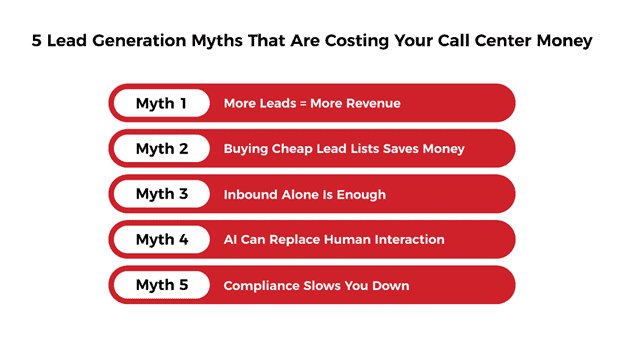
Myth 1: More Leads = More Revenue
Call centers often assume that loading agents with more leads will naturally boost revenue. But volume doesn’t equal value.
When reps spend most of their day chasing people who won’t pick up or aren’t interested, performance drops, not because the team is weak, but because the pipeline is.
Most incoming leads aren’t ready to make a purchase. Many never will be. When agents work on low-intent contacts, the opportunity cost is substantial.
More leads only help if they’re the right leads. Without filtering for intent, you’re not scaling results; you’re just scaling noise.
The Hidden Cost Of Agent Time On Low-Intent Data
Here’s the part many teams overlook: 50–80% of leads never convert (InBeat). That means half, sometimes nearly all, of what agents call isn’t going anywhere.
And every low-intent call has a cost:
- Hours wasted on contacts who were never going to make a purchase.
- Slower response times to genuine prospects.
- Burnout from repetitive, dead-end conversations.
- Lower morale because effort doesn’t match results.
For instance, it is sending your best salesperson into a room where eight out of ten people are only browsing. They’ll still talk to everyone, but the odds are already stacked against them.
If your team spends most of its day on low-quality data, the problem isn’t the agents. It’s the list.
How Predictive Dialers And Smart Routing Improve Lead Prioritization
What actually shifts the needle?
Not more data, better decisions about who your agents speak to first.
Predictive dialers and routing tools help call centers spot the leads that matter by:
- Calling high-intent contacts first.
- Skipping numbers that are flagged as unresponsive.
- Reducing idle time between calls.
- Matching the right agent to the correct type of lead.
It’s a simple change, but the effect is significant. Instead of treating every lead the same, these systems tell your team, “Start here, this person is actually ready to talk.”
If your team usually spends the first hour of the day calling people who never pick up, a predictive system flips the order. Agents start with warm contacts, get early wins, and build momentum for the rest of the shift.
Prioritization isn’t just a workflow upgrade. It directly improves conversion rates, agent morale, and revenue quality.
Stop losing time on unverified leads. NobelBiz gives you compliant, reliable lead generation across every outbound channel.
Stop losing time on unverified leads. NobelBiz gives you compliant, reliable lead generation across every outbound channel.
Brayan Carpio
Senior Call Center Manager, Call4You Marketing
‘The technology aspect of NobelBiz stood out compared to the competition, and also the great team! All the way from onboarding to support to troubleshooting has been great throughout this journey!’
Myth 2: Buying Cheap Lead Lists Saves Money
Cheap data looks good on paper. The price is low. The volume is high.
But call centers quickly learn that “cheap” lists come with hidden costs, low connect rates, compliance risks, and frustrated agents. This is one of the most common myths about call center lead generation, and it can quickly drain budgets.
You pay for the list once, but you pay for the fallout repeatedly.
Why Call Centers Pay Twice For Cheap Data: Low Quality + Remediation?
Many outbound teams purchase low-cost data, believing it will improve the low contact rate despite a high lead volume.
However, cheap lists often have the opposite effect. The numbers are old, recycled, or never qualified in the first place. Agents spend their day calling people who:
- Never opted in
- Don’t remember the brand.
- Aren’t the right fit
- Have disconnected numbers
- Mark calls as spam
It’s one of the biggest misconceptions about outbound call centers that more numbers automatically solve performance gaps.
And the financial hit is real. Poor-quality data costs organizations $12.9M every year. That includes wasted agent hours, low conversion from poor lead quality vs. volume in outbound dialing, time spent fixing bad records, rebuilding lead lists and lost revenue because the genuine buyers never got a call.
Cheap data is like buying a box of broken tools. You’ll spend more fixing the damage than you saved on the purchase.
Compliance Risk From Non-Consented Lists Under TCPA And GDPR
Here’s the part that keeps leaders up at night. Many inexpensive lists lack meaningful consent. That puts call centers at risk for TCPA and regional consent violations, one of the most dangerous compliance and consent myths in lead gen.
Red flags include:
- No timestamp of opt-in
- No source of consent
- Leads scraped from the web.
- Numbers bought from bulk data vendors
- Contacts who never agreed to outreach
When agents call these numbers, they face two problems at once:
- Low intent: people don’t pick up.
- High risk: people report the call.
This leads to spam-labeled calls ruining trust, lower connect rates, and legal exposure. It also creates fear inside the team, the classic TCPA fears — the slowing outreach problem — where agents hesitate to dial because they don’t trust the data.
Cheap lists often feel “fast,” but the compliance fallout is slow, painful, and expensive.
Why Verified, First-Party Leads Boost Connect Rate And Agent Morale
Now compare cheap bulk lists with verified, first-party leads. These contacts actually want to hear from you. They filled out a form, answered a survey, or opted in through a campaign. They’re honest, reachable, and relevant.
That single shift fixes several problems at once such as higher connect rates and fewer spam flags. Safer outreach, better conversations, and less agent burnout from wasting agent time on bad lists.
This is where many myths about contact center lead generation fall apart — outbound is a quality game.
And it affects team morale too.
Imagine spending your day speaking with people who are open, curious, and looking for solutions, instead of calling dead numbers all shift. It’s no surprise that verified leads improve performance and reduce turnover.
High-quality, first-party data also supports better decisions in:
- Cadence planning, avoiding myths about cadence and follow-up timing for outbound calls
- Outreach strategy
- Prioritization
- Agent assignment
As AI enters the picture, first-party consented data becomes even more crucial. Many teams still hold onto AI vs. human performance in contact center lead generation myths, but the real truth is this: AI only works well when the data underneath it is clean, compliant, and accurate.
Verified leads don’t just improve ROI, they protect morale, compliance, and long-term outbound strategy.
“Lead generation doesn’t fail because of agents—it fails because of bad data and outdated beliefs. When your lists are clean and your caller IDs stay trusted, every dial becomes a real opportunity.” – Christian Montes, Chief Operating Officer at NobelBiz

Myth 3: Inbound Alone Is Enough
Some call centers believe that if inbound is performing well, they don’t need outbound. However, relying solely on inbound marketing leaves teams vulnerable to slow months, seasonal dips, and unpredictable demand.
This belief often fuels several common misconceptions about outbound call centers, including the notion that outbound efforts are only relevant when inbound efforts fail. In reality, the strongest teams blend both channels.
Inbound creates interest. Outbound converts opportunity. You need both.
Why Blending Inbound And Outbound Increases Performance
Inbound brings warm leads, people who found you, filled out a form, or reached out on their own. Outbound brings reach, people who match your ICP but may not know you yet.
Together, they reduce the most significant risk in lead generation: inconsistency.
When inbound slows, outbound keeps the pipeline moving. When outbound needs context, inbound insights help shape messaging. This balance also addresses the common myths about contact center lead generation that assume one channel replaces the other.
68% of B2B companies use a mix of inbound and outbound. This mix also helps call centers avoid the typical trade-off between lead quality and volume in outbound dialing. Outbound sales can be tailored to reach better-fit leads based on actual inbound patterns.
A healthy pipeline is built, not discovered. Outbound ensures you never wait around hoping for leads to come in.
Using Omnichannel Workflows To Bridge The Gap
When inbound and outbound operations work together, omnichannel workflows ensure a smooth and natural handoff. Here’s how teams use them:
- Routing inbound leads straight into outbound follow-up sequences.
- Nurturing cold outbound prospects with warm inbound-style content.
- Using SMS, email, and calls to reduce the low contact rate despite high lead volume.
- Triggering outbound callbacks when inbound chatter slows.
- Reducing over-messaging, causing lead fatigue with more brilliant cross-channel timing.
For example, if someone visited a pricing page but didn’t submit a form, outbound can reach out within minutes. That single call often performs better than waiting days for them to fill out an inbound lead form.
These workflows also prevent the common mistakes in outbound sales strategies that occur when channels operate in silos.
Omnichannel keeps the conversation going, no matter where it starts, and ensures leads don’t slip through the cracks.
“AI can accelerate routing and scoring, but it’s your agents who build trust. The real advantage comes when you align human conversation with AI-driven clarity and timing.” – Christian Montes, Chief Operating Officer at NobelBiz
Myth 4: AI Can Replace Human Interaction
There’s a growing belief that AI will eventually do everything an agent does. But AI still can’t replace empathy, tone, trust, or the instinct to adjust mid-conversation.
This is one of the biggest myths about contact center lead generation today. AI is powerful, but it’s not a substitute for human connection. AI handles the heavy lifting. Humans hold the moments that matter.
How AI Enhances Dialing, Routing, And Compliance — Not Empathy
AI does several things exceptionally well:
- Spotting high-intent leads
- Detecting patterns in call behavior
- Routing calls to the right agent
- Reducing outbound sales strategy mistakes
- Improving compliance by flagging risky behaviors
- Predicting the best time to reach each lead
It’s also improving outbound efficiency in real ways. Gartner reports that AI improves lead scoring accuracy by 30–40%. That directly helps teams avoid poor conversion due to low-quality data and reach better-fit contacts first.
But even with all this power, AI still can’t do the human parts of the job — reading emotion, adjusting tone, building trust in sensitive moments, handling complex objections, and navigating personal stories or frustrations.
Think about industries like healthcare, finance, insurance, or legal services. These are places where trust drives the entire conversation. AI can connect you with the right person at the right time, but only a human can make that person feel truly heard.
Why Human Tone And Timing Drive Conversion In Regulated Industries
In regulated industries, a wrong tone can end the conversation before it really starts. People want clarity, reassurance, and someone who understands what’s at stake.
- When a patient sounds nervous about sharing information.
- When a homeowner needs reassurance before giving consent.
- When a business buyer asks, “Is this really worth it?”
- When a prospect hesitates and needs a calm, confident voice.
These scenarios also highlight why the debate over AI vs. human performance in contact center lead generation is misguided. Both matter, but they matter in different ways.
And while AI helps avoid compliance and consent myths in lead gen, humans still need to deliver disclosures, answer questions, and handle objections with care.
The Perfect Balance: AI Insights + Human Connection
The best call centers don’t choose between AI and agents. They combine them. Here’s what that balance looks like:
- AI identifies high-quality contacts
- Humans handle the meaningful conversations.
- AI predicts low contact rate despite high lead volume patterns.
- Humans adjust messaging in real time.
- AI flags risky calls to reduce compliance issues
- Humans add the empathy needed to keep the call moving forward.
For example, AI might suggest that a lead prefers late-afternoon calls, has visited your pricing page twice, and has previously ignored emails. That’s helpful. But when the agent finally connects, they still need to sound human, patient, and confident. AI gets you to the door.
The agent is the one who opens it.
AI can support your team, but it can’t replace your agents. With NobelBiz, your agents get trusted caller IDs, clean routing, and the visibility they need to close more conversations.
“Compliance isn’t a barrier to speed; it’s the foundation of consistent outbound performance. When consent and routing are handled correctly, connect rates rise and revenue follows.” – Christian Montes, Chief Operating Officer at NobelBiz
Myth 5: Compliance Slows You Down
Many call centers still believe that compliance rules slow outreach, hurt productivity, and limit dialing power. But the truth is the opposite: compliance protects your data, your agents, your caller ID reputation, and your revenue.
In a world where spam-labeled calls ruin trust, compliance is no longer optional. It’s a performance driver. Compliance doesn’t slow you down. It keeps you in the game.
Why Compliance-First Actually Speeds Up Results
A compliance-first approach eliminates one of the most significant hidden problems in outbound operations: wasted time on uncallable or risky data.
When compliance is built into your workflow:
- Agents spend more time talking to real, reachable people.
- Caller ID stays clean and trusted.
- Connect rates increase.
- Lists stay usable longer.
- Dialing rules are followed automatically.
- Outreach stays consistent without sudden shutdowns.
Think about the cost of getting it wrong. TCPA violations can add up quickly, ranging from $500 to $1,500 per call. Even a small mistake can turn into a massive hit.
Strong compliance avoids that risk. And without the constant fear of penalties, teams dial with more confidence, not less. This is why many leaders now challenge the outdated myths surrounding compliance and consent in lead generation.
How TCPA, STIR/SHAKEN, And Carrier Vetting Protect Caller ID Trust
Outbound performance depends on trust. If carriers or consumers don’t trust your caller ID, even the best agents won’t get through. That’s where modern compliance frameworks come in:
- TCPA ensures you’re calling with consent and proper disclosures
- STIR/SHAKEN verifies your caller identity to carriers
- Carrier vetting helps you avoid flags and blocks before they happen.
These protections directly reduce call blocking, spam labeling, dropped connect rates, complaints, agent frustration, and wasted time on unproductive dials.
If your number is flagged, even perfect scripts and top-tier agents can’t fix the connect-rate problem. This is why compliance is closely tied to lead quality vs. volume in outbound dialing — when carriers trust your traffic, your outbound volume actually becomes more effective.
Compliance protects your number, your reputation, and your ability to reach the leads you paid for.
NobelBiz Compliance-First Tools That Maintain Uptime And Legitimacy
Compliance-first approach to protect call centers from downtime, blocking, and regulatory risk. Their compliance and security framework helps teams stay legitimate, protected, and operational without slowing outreach.
NobelBiz tools support:
- STIR/SHAKEN–ready calling
- Dynamic caller ID management
- Carrier-level vetting
- Data protection and secure routing
- Real-time risk detection
- High uptime and consistent delivery
- Compliant dialing workflows
- DNC and consent management
In practice, that means fewer disruptions, fewer blocks, and fewer compliance surprises. Agents spend more time connecting with real prospects and less time worrying about what they’re allowed to say or who they’re allowed to call.
This also reduces outbound sales strategy mistakes caused by unclear rules, messy data, or inconsistent compliance training.
When compliance is built into your tools, you don’t have to slow down to stay safe; the safety is already baked in.

Clinical Trial Media
Mo Pene |
Contact Center Technology Manager @ CTM
‘Thanks to NobelBiz, we now enjoy a robust, scalable communication system tailored to our growing needs, empowering us to deliver personalized care experiences more efficiently and boosting our overall revenue.’
Final Thoughts: Busting Myths, Protecting Profit
These myths don’t just create confusion; they cost you real money. When you rely on cheap data, slow compliance processes, or outdated beliefs about inbound marketing or AI, the impact is evident in lower connection rates, wasted agent hours, and missed revenue.
Your success in 2025 will come down to a few core factors:
Compliance, cadence, and call quality. These are the levers that actually change performance. They protect your caller ID, improve conversions, and help your team focus on the leads that matter.
The future belongs to call centers that strike a balance between precision, speed, and consent. That means using AI to support your agents, keeping your data clean, and following the rules that protect your reputation. When you combine these pieces, you move faster, stay safer, and create a more predictable path to revenue.
In the end, it’s simple: when you cut through the myths and focus on what works, you give your agents the tools they need to connect, convert, and perform at their best.
Transform Your Lead Generation With NobelBiz Support
You’ve seen how these lead generation myths drain your budget: cheap lists, blocked caller IDs, low connect rates, and compliance headaches that slow your team down. Every one of these issues eats into your margins and makes outbound more expensive than it needs to be.
This is precisely where NobelBiz helps you turn things around. The platform protects your caller ID reputation, improves delivery, verifies consent, and keeps your outbound traffic trusted. You get reliable reach, compliant routing, and consistent performance built in, so your team spends less time fixing problems and more time connecting with real prospects.
Stop wasting time on bad data. Partner with NobelBiz to power compliant, high-performance lead generation across voice, SMS, and email.
Frequently Asked Questions
Discover how NobelBiz helps call centers maximize customer engagement, boost answer rates, and ensure compliance with industry-leading solutions.

Michael McGuire is a contact center industry expert with almost two decades of experience in the space. His experience includes roles as Director of Contact Center Digital Transformation at NobelBiz, and as Director of Operations at FLS Connect, managing multiple call centers. As President of Anomaly Squared and Targeted Metrics, Michael successfully transitioned companies into remote operations and significantly boosted revenues. With a strong background in customer service, leadership, strategic planning, and operations management, Michael excels in driving growth and innovation in the call center space.
Mike is also a proud Board Member for R.E.A.C.H Trade Group, promoting consumer protection and satisfaction and Co-host of the Off Skripted Podcast – a show about Life, Call Centers and everything in between.